How Much to Feed a Labradoodle: Feeding Chart by Age and Weight
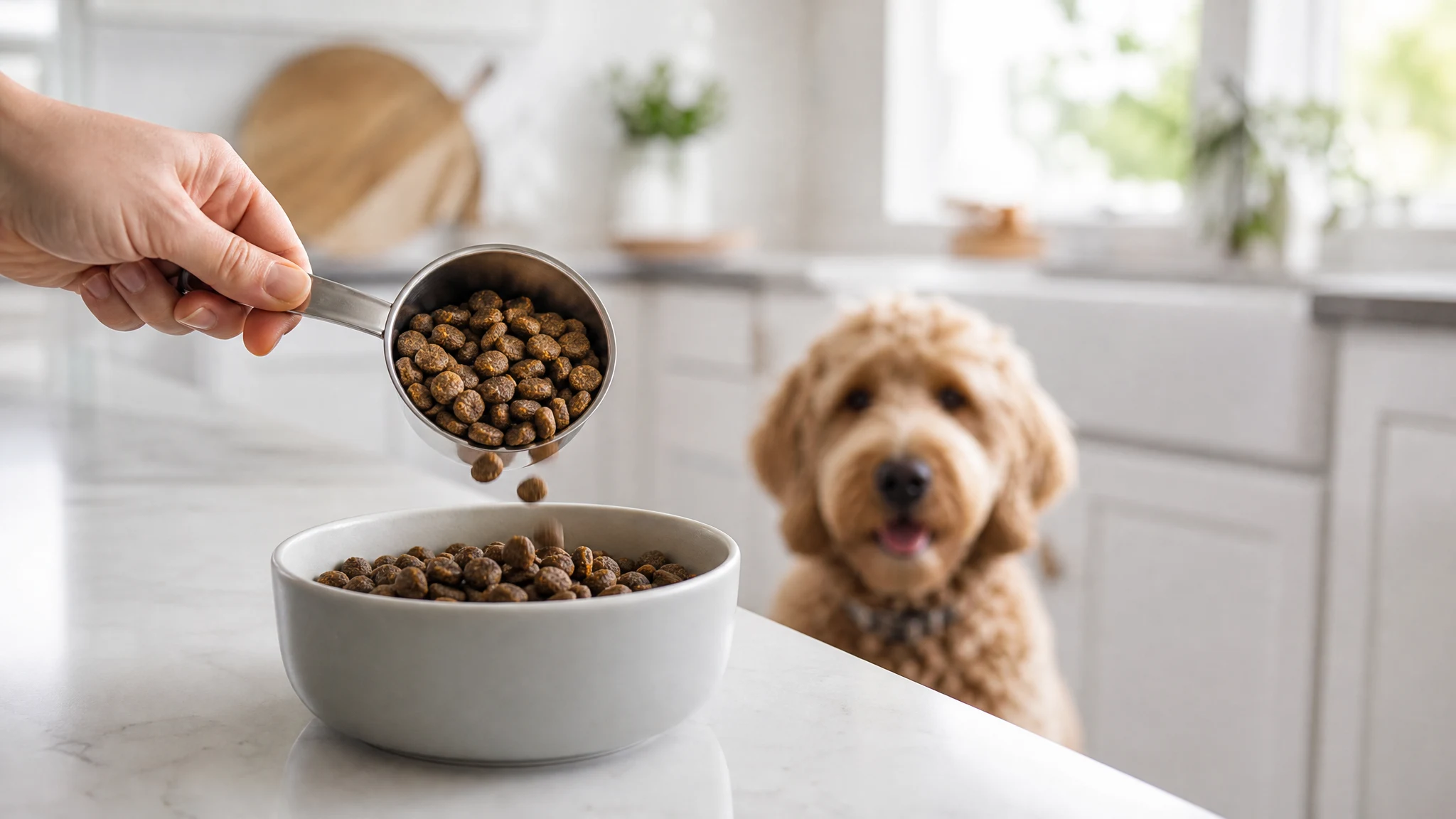
General nutrition information compiled from product labels and published sources, not veterinary advice. Your veterinarian is the right person to choose a diet for your dog, especially one with a health condition.
Owners often ask how much a Labradoodle should eat, and the honest answer is that no single number fits every dog. Labradoodles range from compact miniatures to large standards, and activity, age and metabolism vary just as much.
This guide shows you how to build a starting amount from a food's own label, check it against your dog's body, and adjust. The feeding chart below uses real label data from named foods. Treat every figure as a starting point. A veterinarian sets the amount for an individual dog.
How we built this chart
We compared label data from the brand pages listed at the end. We did not run feeding trials or taste tests, and we did not feed these foods to dogs. The chart shows what each brand publishes, not how any food performs.
None of these brands makes a Labradoodle-specific formula that we could find. The Royal Canin foods are made for purebred Labrador Retrievers, so they are listed only as label examples. Check with each brand if you want to know whether a formula suits a mixed-breed dog.
Materials you will need
- The bag, can or pack of the food you plan to feed, with its calorie statement and feeding guide.
- A kitchen scale that reads in grams or ounces. Royal Canin notes that grams are the most accurate way to measure, and that cup amounts are only approximate.
- A standard dry measuring cup.
- A notebook or phone note for weekly weights and body condition notes.
- Your dog's current weight, from a home scale or a veterinary visit.
- A list of treats and chews your dog gets each day.
Step 1: Know your Labradoodle's size
Labradoodles vary a great deal. The Basepaws Labradoodle breed page gives an average of 50 to 75 lb for a male Standard and 15 to 45 lb for a Miniature. Other breed pages give different ranges, so sources do not agree. Your own dog's weight and your veterinarian's view matter more than any average.
| Variety | Typical adult weight (Basepaws) | Why it matters for feeding |
|---|---|---|
| Miniature | 15 to 45 lb | Smaller bodies need fewer total calories. Large-breed puppy rules usually do not apply. |
| Standard | 50 to 75 lb average male | Can approach the 70 lb line that AAFCO uses for large-size growth. |
A dog that lands near that 70 lb line may need a puppy food that is labeled for large-size growth. Ask your breeder or veterinarian to estimate your puppy's adult size.
Step 2: Match the food to the life stage
The AAFCO statement on the label tells you which dogs a food is made for. Look for "maintenance" for adults, "growth" for puppies, or "all life stages." Brands also set their own age bands:
- Puppies: Royal Canin's Labrador Retriever Puppy is for dogs up to 15 months. Hill's Science Diet Puppy Large Breed covers puppies up to 18 months that will be over 55 lb as adults.
- Adults: Hill's Science Diet Adult wet food is for dogs 1 to 6 years old. Royal Canin's Labrador Retriever Adult is for dogs 15 months and older.
- Mature dogs: Hill's Adult 6+ Large Breed is for dogs 6 and older. Royal Canin's Adult 5+ is for dogs 5 and older.
We could not find a source that says when a Labradoodle counts as an adult, so check with your veterinarian about when to switch. For a Standard-size puppy, the Whole Dog Journal explains that AAFCO sets a lower maximum calcium for large-size growth. It advises choosing a puppy food whose statement says "including growth of large-size dogs." Victor Hi-Pro Plus Large Breed Puppy, Nom Nom Chicken Cuisine and JustFoodForDogs Chicken & Rice carry that wording. Victor Hi-Pro Plus (the non-large-breed version) says "except for growth of large size dogs," so it is not a fit for a large-size puppy.
Step 3: Read the label's calories and feeding guide
Foods differ a lot in how many calories fit in a cup. A cup of one food is not the same as a cup of another. Always start from the calorie figure and the guide on the product you actually buy.
| Food (brand page) | Label calories | Cups or amount that gives 100 kcal* | What the label says about amounts |
|---|---|---|---|
| Royal Canin Labrador Retriever Adult (dry) | 306 kcal per cup | about 1/3 cup | A guide only. Grams are the most accurate measure. |
| Royal Canin Labrador Retriever Puppy (dry) | about 307 kcal per cup | about 1/3 cup | Chart is an image. The page points to a tool to work out the amount. |
| Royal Canin Labrador Retriever Adult 5+ (dry) | 277 kcal per cup | about 0.36 cup | Depends on weight and activity. The chart gives low, medium and high activity amounts. |
| Hill's Science Diet Puppy Large Breed (dry) | 387 kcal per cup | about 0.26 cup | Adjust amounts as needed to maintain optimal weight. |
| Hill's Science Diet Adult 6+ Large Breed (dry) | 352 kcal per cup | about 0.28 cup | Adjust amounts as needed to maintain optimal weight. |
| Hill's Science Diet Adult Chicken & Barley (13 oz can) | 369 kcal per can | about 0.27 can | 10 lb dog: 1 can a day. 50 lb dog: 3 1/4 cans a day. |
| Victor Hi-Pro Plus Large Breed Puppy (dry) | 365 kcal per cup | about 0.27 cup | Add 1/2 cup for every 20 lb over 100 lb. |
| Victor Hi-Pro Plus (dry) | 406 kcal per cup | about 0.25 cup | Add 1/2 cup for every 20 lb over 100 lb. |
| Freshpet Tender Chicken Recipe (fresh) | 316 kcal per 1/2 lb | about 2.5 oz | Based on dog weight. The daily amount can be one meal or split into two. |
| JustFoodForDogs Chicken & Rice (fresh) | 774 kcal per 18 oz pack (43 kcal per oz) | about 2.3 oz | No fixed amount. The page points to a feeding calculator. |
| Nom Nom Chicken Cuisine (fresh) | 244 kcal per cup | about 0.41 cup | Portions vary with age, weight and activity. Use the brand's Daily Feeding Guide. |
*The 100 kcal column is our own arithmetic on the brand's published calorie figure (100 divided by the label calories). It is not a feeding recommendation. It only shows how differently the same-sized scoop can fill a bowl.
Several brand pages we reviewed do not publish a full chart of amounts by weight in text form. Where that is the case, use the brand's own calculator or the chart printed on the package.
Step 4: Build a feeding chart by weight
The one label in our comparison that gives plain weight-based amounts is the Hill's Science Diet Adult Chicken & Barley can. Its guide lists 1 can a day for a 10 lb dog and 3 1/4 cans for a 50 lb dog. At 369 kcal per can, that works out to roughly 369 kcal and roughly 1,200 kcal a day. That is the arithmetic of the label, not advice for your dog.
To make a chart for your own Labradoodle, follow this process:
- Find your dog's current weight and life stage.
- Open the brand's feeding guide or calculator for the food you chose.
- Write down the daily amount for your dog's weight, in grams if the label offers it.
- Divide the daily amount into meals. Most adult dogs do well on two. Freshpet says its daily quantity can be fed as one meal or split into two. Ask your veterinarian what suits your puppy.
- Record the starting amount, the date and the food's calorie figure in your notebook.
Recheck the amount whenever your dog's weight changes, since a puppy's chart changes quickly as the dog grows.
Step 5: Score your dog's body condition
The scale tells you weight, but not whether that weight is healthy for your dog's frame. Body condition scoring fills the gap. Veterinary teams commonly use a nine-point scale, where about 4 to 5 is considered ideal. Ask your veterinarian to show you how it works on your own dog. You can check at home with three quick looks:
- Ribs: You should feel them under a thin layer of padding without pressing hard. A Labradoodle's curly coat can hide the shape, so use your hands, not just your eyes.
- Waist: From above, there should be a gentle tuck behind the ribs.
- Belly: From the side, the belly should rise slightly toward the back legs rather than hang level or sag.
If ribs are hard to feel and the waist has disappeared, your dog may be carrying extra weight. If ribs, hips and spine are very easy to see or feel, your dog may be too thin. Either way, talk with your veterinarian before changing the amount a lot.
Step 6: Adjust for activity
The Royal Canin Adult 5+ guide shows low, medium and high activity amounts, which tells you that activity changes the right number. A Labradoodle who hikes or swims several times a week uses more energy than one who naps most of the day.
- Start at the label amount for your dog's current weight.
- Weigh your dog and score body condition every two weeks. Puppies need a closer watch.
- If weight and body condition hold steady, keep the amount.
- If weight drifts up or down, change the daily amount by a small step and recheck in two weeks. Ask your veterinarian how big a step is sensible.
- Count treats. Chews and training rewards add calories, so take them out of the daily total.
Hill's repeats the same idea on its labels: adjust feeding amounts as necessary to maintain optimal weight.
Tips for Labradoodle owners
- Weigh by grams. A scoop can vary by 10 percent or more depending on how you fill it. Brands that publish gram amounts are giving you the more precise number.
- Slow down fast eaters. A breed page from Chewy lists eating quickly and digestion issues as things to watch in the breed. A slow-feeder bowl or a puzzle mat may help. Ask your veterinarian if your dog gulps food or vomits after meals.
- Change foods gradually. Mix the new food in with the old over about a week unless your veterinarian says otherwise.
- Watch the whole body. Breed pages mention hip and elbow dysplasia, mainly in larger Standard dogs, and skin sensitivity. Keeping a healthy weight is one part of overall care. No food prevents or treats these conditions, and your veterinarian decides what is right for a dog with a health concern.
- Do not copy a friend's amount. Another Labradoodle may weigh half as much or burn twice the energy.
Common mistakes to avoid
- Using the cup number from a different food. The cup calories in the table range from 244 to 406. Switching foods without recalculating can change intake a lot.
- Feeding an adult food to a large puppy, or the reverse. Check the AAFCO statement for "including" or "except for" growth of large-size dogs.
- Judging by the coat. A fluffy coat can make a thin dog look healthy and a heavy dog look sturdy. Feel the ribs.
- Forgetting treats and toppers. They count toward the daily total.
- Chasing a grain-free label. The FDA's investigation into diet and canine dilated cardiomyopathy (DCM) has had no new public update since December 23, 2022, and the agency says it will not post more until there is meaningful new scientific information. If you have questions about your dog's heart or diet, ask your veterinarian.
- Making big changes alone. If your dog needs to lose or gain a lot of weight, a veterinarian should plan the amounts. Prescription diets are something only a veterinarian prescribes.
What results to expect
With a label amount, regular weigh-ins and small adjustments, many owners find their dog holds a steady weight and a healthy body condition. Puppies should grow at a steady pace rather than a rush. Results vary by dog, and a label guide cannot predict them.
If your dog's weight keeps climbing or falling, appetite changes suddenly, or stools stay loose, call your veterinarian. Those are signs for a professional to look at, not for another round of guesswork with the scoop.
The bottom line
How much a Labradoodle should eat depends on the dog's size, age, activity and the calories in the food. Use the brand's guide as a starting point, weigh the portions, score body condition and adjust slowly. Your veterinarian sets the final amount for your individual dog.
Sources
- Basepaws Labradoodle breed page
- Whole Dog Journal: In the Fine Print, Nutritional Adequacy Statements
- FDA Center for Veterinary Medicine: investigation into diets and canine dilated cardiomyopathy
- Royal Canin Labrador Retriever Adult
- Royal Canin Labrador Retriever Puppy
- Royal Canin Labrador Retriever Adult 5+
- Hill's Science Diet Puppy Large Breed
- Hill's Science Diet Adult 6+ Large Breed
- Hill's Science Diet Adult Chicken & Barley canned
- Victor Hi-Pro Plus Large Breed Puppy
- Victor Hi-Pro Plus
- Freshpet Tender Chicken Recipe
- JustFoodForDogs Chicken & Rice Recipe
- Nom Nom Chicken Cuisine