Best Training Treats for Labradoodles (and How Many to Give)
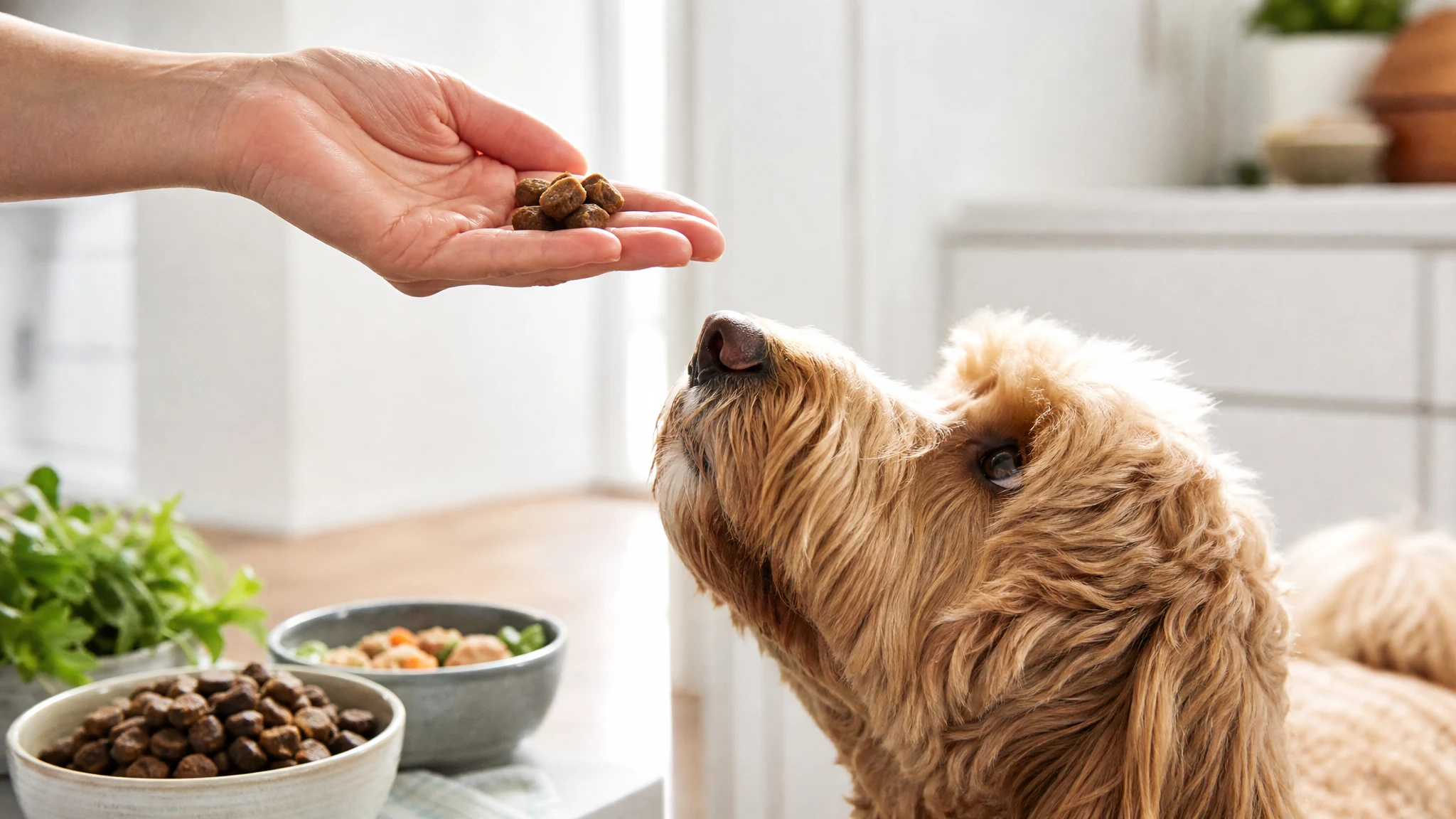
General nutrition information compiled from product labels and published sources, not veterinary advice. Your veterinarian is the right person to choose a diet for your dog, especially one with a health condition.
Training goes better when the reward is worth working for. It goes worse when the treats quietly add up to a second dinner. This guide shows you how to choose the best treats for Labradoodles, cut them to a useful size, and count them against your dog's daily food.
We compared label logic and published guidance. We did not run taste tests or feeding trials, so nothing here claims one treat beats another in a real dog's bowl.
What you need
- Two or three treat types in different value levels (see the categories below).
- A small cutting board and a knife or kitchen scissors.
- A treat pouch or a small container you can reach quickly.
- Your dog's current daily food amount, from the food label or your veterinarian.
- A notebook or phone note to track treats for a week.
Step 1: Know your dog's size
Labradoodles vary a lot. Basepaws, a breed information page, lists Standard males at roughly 50 to 75 pounds and Miniatures at roughly 15 to 45 pounds. Chewy's breed page gives somewhat different ranges, so sources disagree. Your own dog's weight and your veterinarian's advice matter more than any average.
Why this matters for treats: a 20 pound Miniature and a 65 pound Standard have very different calorie needs. A treat that is a nibble for one is a real snack for the other.
Step 2: Pick a treat category
You do not need a specific brand to train well. Think in categories, then read the label of whatever you choose.
Soft training treats
These are small, moist and easy to break apart. They suit fast repetition, like practicing sit or name recognition. Look for a short ingredient list you can understand, and check whether the package gives a calorie count per treat. Many do not, which makes counting harder.
Freeze-dried single protein treats
These are made from one animal protein, such as one kind of meat. They are usually strongly scented, which makes them useful for high-distraction places like a busy sidewalk. They crumble easily, so you can break them into tiny pieces.
A single protein also makes it easier to spot a problem. Basepaws notes skin sensitivity and allergy-related itching among Labradoodle concerns. If your dog has itchy skin, ask your veterinarian before changing treats, and introduce only one new item at a time.
Vegetables
Some dogs happily work for small pieces of plain vegetables. They are a lower-calorie option for practice sessions at home. Not every dog likes them, and not every vegetable is safe for dogs, so confirm the specific item with your veterinarian before using it. Skip seasoning, oil and butter.
A piece of your dog's own food
Part of the daily meal can double as a reward. This is the simplest way to avoid extra calories. Labels such as the Royal Canin Labrador Retriever Adult page list calories per cup (306 kcal ME per cup, as fed, calculated) so you can see what a handful of kibble is worth. That is a Labrador formula, not a Labradoodle one. We found no Labradoodle-specific formula, and you should check with the brand if you have questions about suitability.
Step 3: Learn the 10 percent rule
The World Small Animal Veterinary Association (WSAVA) calorie guidance commonly cited for treats is simple: keep treats to about 10 percent of a dog's daily calories, with the rest coming from a complete and balanced food. Ask your veterinarian whether that number fits your dog, especially if your dog is overweight, a growing puppy, or has a health condition.
Here is a made-up example to show the math, not a recommendation. If a dog's daily target were 1,000 calories, treats would be capped near 100 calories. If a soft treat has 5 calories, that is about 20 treats. If a freeze-dried piece has 10 calories, it is about 10 pieces.
- Find your dog's daily calorie target from your veterinarian or the food's feeding guide.
- Multiply by 0.1 to get the treat budget.
- Find the calories per treat on the package or the brand's website. If the brand does not list it, ask the brand directly.
- Divide the budget by calories per treat to get the daily count.
Feeding guides on food labels are starting points. The Hill's Science Diet pages, for example, say to adjust amounts as necessary to maintain optimal weight. Treat calories belong in that adjustment, so reduce meals a little on heavy training days.
Step 4: Cut treats to the right size
Smaller is better. Your dog is rewarded by the act of getting a treat, not by chewing it.
- Standard Labradoodles: about the size of a pea or a pencil eraser.
- Miniatures: about half that, roughly lentil-sized.
- Puppies: smaller still, so a session of 20 rewards is not a big meal.
Chewy's breed page notes that Labradoodles can eat quickly. Tiny, soft pieces are easy to swallow in one go. If your dog gulps, hand-deliver one piece at a time rather than tossing a pile, and ask your veterinarian about slowing down mealtimes.
Step 5: Set up a short, rewarding session
- Pick a calm spot. Start in a quiet room before moving outdoors.
- Prepare your treats first. Cut them ahead of time so the reward arrives within a second or two of the behavior.
- Mark and reward. Say a short word like "yes" the instant your dog does the right thing, then deliver a treat.
- Keep sessions short. Three to five minutes is plenty. End while your dog is still interested.
- Raise value with difficulty. Use the lower-value treat for easy skills at home and the stronger-scented one for harder tasks or distractions.
- Fade treats gradually. Once a behavior is reliable, reward it every second or third time, mixing in praise, play or a toy.
This reward-based approach matches the American Veterinary Society of Animal Behavior (AVSAB) position. Training that relies on punishment or intimidation is not part of it.
Puppies: a note on growth
Treats do not replace a growth-appropriate main food. Whole Dog Journal explains that growth foods carry an AAFCO statement either including or excluding growth of large-size dogs (70 pounds or more as an adult), and that the large-size version limits maximum calcium. A Standard Labradoodle can approach that line.
The practical point for treats: they are not usually the main source of calcium or nutrients, so keep them small and few, and let the complete puppy food do the heavy lifting. For help choosing that food, see our comparison of foods by label data.
Tips that help
- Keep a treat log for one week. Write down every treat, including dental chews and bits from family members. Most people undercount.
- Use a rotation. A couple of different treats keeps your dog interested. Change one thing at a time.
- Read the first ingredients. Ingredients are listed by weight. The label tells you what is in the bag, not how well your dog will do on it.
- Look for a calorie statement. If a package gives none, treat that as a gap and ask the maker.
- Store treats well. Soft treats can spoil faster than dry ones. Follow the package's storage directions.
- Be wary of big marketing claims. Words like "natural" or "premium" do not tell you the calories or the ingredient quality.
Common mistakes to avoid
- Treats that are too big. This is the most common way the budget disappears.
- Not counting treats at all. Ten small pieces may be fine. Thirty big ones may not be.
- Changing several things at once. If your dog has an upset stomach or itchy skin, you will not know which item was the cause.
- Using treats to fix a skipped meal. A treat is not a complete diet. Foods labeled complete and balanced for a life stage, like the ones on the Royal Canin, Hill's, Victor and fresh-food pages, say so in an AAFCO statement. Treats generally do not.
- Offering human foods without checking. Some common foods are harmful to dogs. Ask your veterinarian for a list before sharing.
- Using food to calm anxiety or boredom. That can build habits that are hard to undo. Offer a walk, play or a puzzle instead.
What to expect
Used consistently, small, well-timed treats may help your Labradoodle learn new cues more quickly and stay interested in sessions. Results depend on the dog's age, temperament, the setting, and how regularly you practice. Some dogs pick up a cue in days, others take weeks.
Counting treats toward daily calories may help you keep your dog's weight steady, but it is not a guarantee. No treat prevents or treats any health problem. If you have concerns about hip or elbow health, skin, digestion, or weight, your veterinarian decides what is right for an individual dog, including whether a prescription diet is appropriate.
Check in on your dog's body condition every few weeks. If you see weight creeping up, trim meal portions or treat counts and ask your veterinarian for a target.
Quick checklist
- Know your dog's weight and daily calorie target.
- Choose one or two treat categories and read the labels.
- Cap treats at about 10 percent of daily calories unless your veterinarian says otherwise.
- Cut pieces to pea size or smaller.
- Keep sessions short, reward-based and upbeat.
- Log treats for a week and adjust meals if needed.