Wet vs Dry vs Fresh Food for Labradoodles
General nutrition information compiled from product labels and published sources, not veterinary advice. Your veterinarian is the right person to choose a diet for your dog, especially one with a health condition.
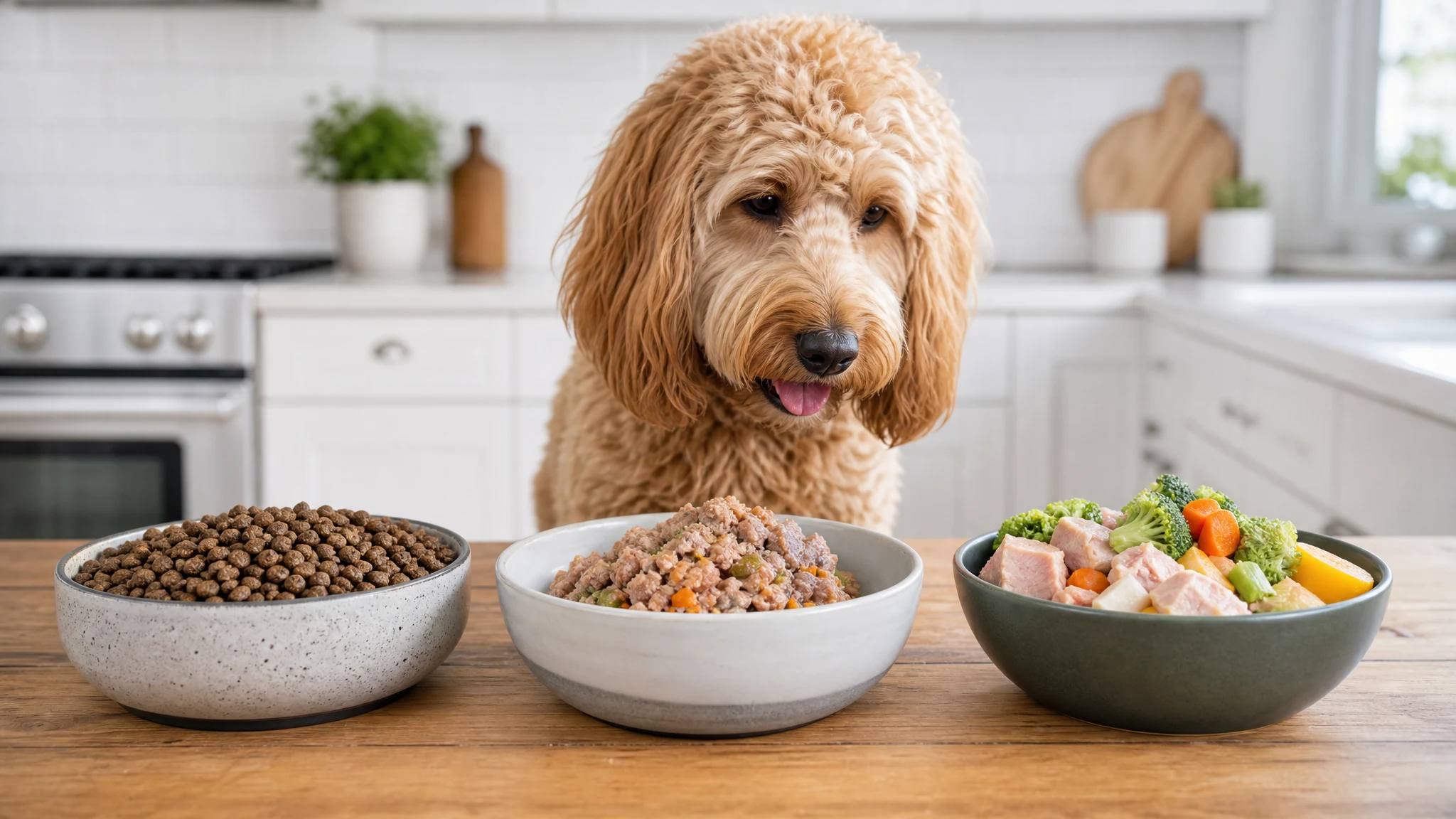
The wet vs dry dog food question gets harder once fresh food joins in. Each form can be complete and balanced. They differ in water content, calories per scoop, handling, and how much of your day and budget they take.
This page compares the three forms for Labradoodles using label data from the brands' own product pages. We compared labels. We did not run feeding trials or taste tests, so nothing here says how a dog liked a food or how it did on one.
First, what a Labradoodle changes
Labradoodles vary a lot in size. Basepaws lists Standards at roughly 50 to 75 lb for an average male and Miniatures at 15 to 45 lb, and notes that sources differ. A Standard can get close to the 70 lb line that AAFCO uses for large-size puppy growth. A Miniature will not.
That matters for two reasons. A big dog needs a lot of food, so the calories in each cup or can add up. And a Standard puppy needs a food whose label says it covers growth of large-size dogs. Whole Dog Journal explains that the large-size version of the growth standard has a lower maximum calcium level.
We found no food made specifically for Labradoodles. The Royal Canin products in this comparison are made for purebred Labrador Retrievers, and they are included only as a label reference point. Ask the brand or your veterinarian whether a breed formula makes sense for your dog.
The comparison at a glance
| Attribute | Dry | Wet (canned) | Fresh |
|---|---|---|---|
| Moisture | Low. Ingredient lists start with solids such as chicken meal or corn. | High. The Hill's Science Diet canned recipe lists water first. | High. Freshpet lists chicken broth among its first five ingredients. |
| Calories on the label | 306 to 406 kcal per cup in the products reviewed | 369 kcal per 13 oz can (Hill's Science Diet) | 244 kcal per cup (Nom Nom); other fresh brands list calories per pack or per half pound |
| Storage and handling | Pantry storage, easy to measure | Open cans need refrigeration; check the brand | Brand-specific, usually cold storage; check the brand |
| Cost per day | Generally the lowest of the three for a large dog | Generally higher for a large dog | Generally the highest for a large dog |
| Large-size puppy statements | Some products, not all | Hill's canned recipe is adult maintenance only | JustFoodForDogs and Nom Nom, yes; Freshpet, adult only |
| Kibble size | Not listed on the product pages reviewed | Not applicable | Not applicable |
The cost row is a general pattern, not a price. We did not use prices, because none appear on the label data. Check each brand for current pricing and shipping terms.
Dry food
Dry food is what most households start with. The products compared here include Royal Canin Labrador Retriever Adult, Hill's Science Diet Puppy Large Breed, and two Victor Hi-Pro Plus formulas.
Pros
- Easy to store, scoop and weigh.
- Calories per cup vary by product, from 306 kcal for Royal Canin Labrador Retriever Adult to 406 kcal for Victor Hi-Pro Plus. That range is wide, so a cup of one food is not a cup of another.
- The most choices by life stage. Hill's Science Diet Puppy Large Breed and Victor Hi-Pro Plus Large Breed Puppy both carry large-size growth language.
- Usually the least costly way to feed a big dog, because calories are packed into each cup.
Cons
- Low moisture, so the dog gets less water from the bowl itself.
- Easy to overfeed by eye. Weigh portions or use a measuring cup.
- Labels can look similar while the foods differ. Victor Hi-Pro Plus says it is for all life stages except growth of large-size dogs, while the Large Breed Puppy version includes it. Read the exact AAFCO sentence.
Wet food for Labradoodles
Wet food for Labradoodles is most often used as a topper, a bowl-sweetener, or a full diet for dogs that eat poorly. The only canned product in the data is Hill's Science Diet Adult Chicken & Barley Entree. Its AAFCO statement says feeding tests substantiate complete and balanced nutrition for adult maintenance.
Pros
- High moisture. Water is the first ingredient on the Hill's can.
- Strong smell and soft texture, which some picky eaters accept more readily.
- Can be fed alone or alongside dry food.
Cons
- The volume adds up for a big dog. Hill's gives 1 can per day for a 10 lb dog and 3 1/4 cans for a 50 lb dog. At 369 kcal per can, that is roughly 1,200 kcal for the 50 lb dog from cans alone, which is a lot of cans to open, store and carry out.
- Open cans need to be handled and stored carefully.
- A canned adult recipe is not a puppy food. Check the statement before feeding it to a growing Standard.
The Hill's page lists protein, fat and fiber only as dry matter averages (26.7%, 16.7% and 1%). Those are not the same as the as-fed minimums on dry foods, so do not compare the numbers directly with a kibble bag.
Fresh dog food for Labradoodles
Fresh dog food for Labradoodles covers refrigerated or delivered recipes. The data includes Freshpet Tender Chicken Recipe, JustFoodForDogs Chicken & Rice, and Nom Nom Chicken Cuisine.
Pros
- Short, recognizable ingredient lists. JustFoodForDogs starts with chicken, white rice, brown rice, carrots and kale. Nom Nom starts with chicken, sweet potatoes, squash, spinach and dicalcium phosphate.
- Two of the three carry the AAFCO statement for all life stages including growth of large-size dogs (70 lb or more as an adult). That makes them usable for a Standard puppy, if your veterinarian agrees.
- High moisture, and many dogs like the texture.
Cons
- Likely the highest cost per day for a big dog. Fresh foods are lower in calories by volume. Nom Nom lists 244 kcal per cup, and JustFoodForDogs lists 774 kcal ME per 18 oz pack.
- Freshpet's recipe is adult maintenance only, so it is not a fit for a Standard puppy.
- Handling matters. These foods need cold storage and planning, and the delivery brands depend on a subscription schedule.
- Feeding amounts come from each brand's calculator. JustFoodForDogs and Nom Nom direct you to their own tools, so use those as a starting point and adjust with your veterinarian.
Comparing protein and fat across forms
Kibble minimums look far higher than fresh minimums. Royal Canin Labrador Retriever Adult lists 28% protein minimum, and Victor Hi-Pro Plus lists 30%. Freshpet lists 9.5%, JustFoodForDogs 8% and Nom Nom 6.5%.
That gap mostly reflects water. A food that is mostly water has less of everything else per pound. Comparing as-fed numbers across forms is misleading, and only a dry matter conversion puts them on equal footing. Hill's gives dry matter figures on both its dry puppy page and its canned page, so those two are the easiest to compare.
Dental myths
One common belief is that dry food cleans teeth and wet food ruins them. None of the sources used here make that claim, and we did not find label data on dental effects for any of these products. A food's form is not a substitute for dental care.
If you are weighing teeth against form, ask your veterinarian about your individual dog's mouth.
Mixing forms
Mixing is common. A spoonful of wet or fresh food over kibble is an easy way to add interest.
Count the extra calories. If you add wet or fresh food, reduce the dry portion so the daily total stays near what the label guide suggests. Label guides are starting points, as Hill's says: adjust amounts as necessary to maintain optimal weight.
If you mix, keep the life stage consistent. A Standard puppy needs every part of the diet to suit large-size growth, so check that the topper does too. Adult-only recipes are not meant as the main food for a growing puppy.
Best for, by use case
- Everyday feeding on a practical budget: dry food. It is the simplest to measure, store and afford, especially for a Standard.
- A Standard puppy: any form, as long as the label includes growth of large-size dogs. Hill's Puppy Large Breed, Victor Hi-Pro Plus Large Breed Puppy, JustFoodForDogs and Nom Nom all state this.
- A Miniature puppy: check the label for a growth statement. Large-size language is not needed for a dog that will stay well under 70 lb, but ask your veterinarian.
- A picky eater: wet or fresh food as a topper, with calories counted.
- A dog that gulps food: one breed education page from Chewy notes Labradoodles can eat quickly. Wet and fresh foods are softer, but how a dog eats depends on the dog. Ask your veterinarian about slowing down mealtime.
- A dog with skin sensitivity or itching: Basepaws lists skin sensitivity as a concern for the breed. No form is shown to fix it. Your veterinarian decides whether a diet change makes sense.
- A senior dog: Royal Canin Labrador Retriever Adult 5+ and Hill's Adult 6+ Large Breed are dry options with adult maintenance statements. Calories per cup are lower, at 277 and 352 kcal. Ask your veterinarian what suits your dog.
What about grain-free and DCM?
Every product in this comparison is listed as grain-containing except Nom Nom, whose grain-free status we could not confirm. The FDA's investigation into a possible link between certain diets and canine dilated cardiomyopathy has not had a public update since December 23, 2022, and the FDA said it would not issue more until there is meaningful new scientific information. If you have questions about your dog's heart or diet, your veterinarian is the person to ask.
Verdict
For most Labradoodle owners, dry food is the practical default. It is the easiest to measure and has the most options by life stage, and it is generally the least expensive way to feed a large dog.
Wet food works best as a partner to dry, not as the whole diet for a Standard. The number of cans a big dog needs makes full wet feeding a lot of work.
Fresh food is a reasonable choice if the budget, the storage space and the delivery schedule fit your household. It is not nutritionally better by default. Check the AAFCO statement, because only some fresh recipes carry large-size growth language.
Whatever you choose, pick a food whose statement matches your dog's life stage and expected adult size, weigh the portions, and check weight and body shape every few weeks. For a closer look at individual products, see our foods compared by label data.
No food prevents or treats hip dysplasia, allergies or any other condition. Your veterinarian decides what is right for an individual dog, and prescription diets come only from a veterinarian.
Sources
- Basepaws Labradoodle breed page
- Whole Dog Journal: In the Fine Print, Nutritional Adequacy Statements
- FDA Center for Veterinary Medicine: DCM investigation
- Royal Canin Labrador Retriever Adult
- Royal Canin Labrador Retriever Adult 5+
- Hill's Science Diet Puppy Large Breed
- Hill's Science Diet Adult 6+ Large Breed
- Hill's Science Diet Adult Chicken & Barley Entree
- Victor Hi-Pro Plus Large Breed Puppy
- Victor Hi-Pro Plus
- Freshpet Tender Chicken Recipe
- JustFoodForDogs Chicken & Rice Recipe
- Nom Nom Chicken Cuisine