Best Puppy Food for Labradoodle Puppies
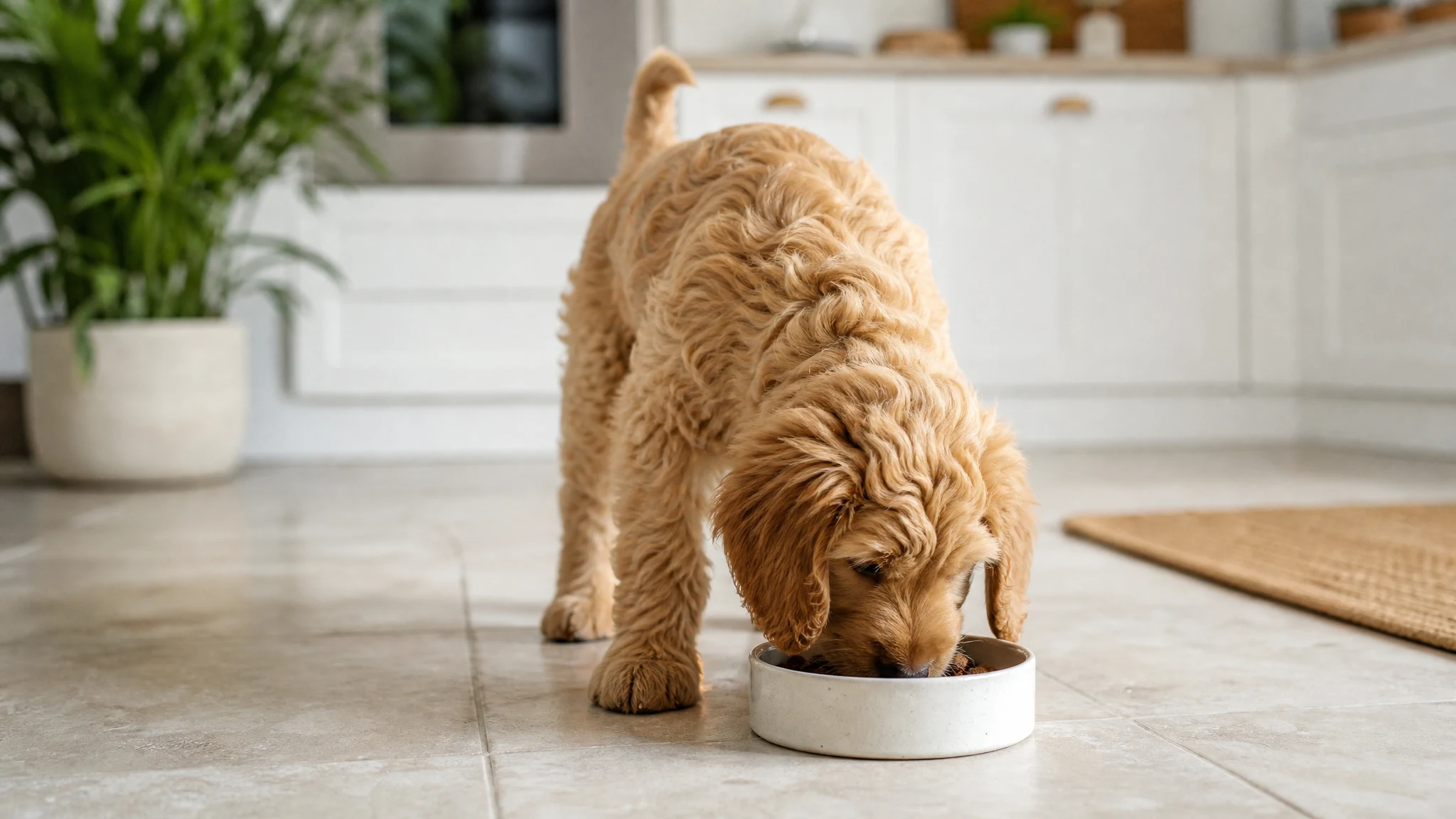
General nutrition information compiled from product labels and published sources, not veterinary advice. Your veterinarian is the right person to choose a diet for your dog, especially one with a health condition.
Choosing the best puppy food for Labradoodles is harder than it looks, because Labradoodles come in very different sizes. A miniature and a standard can both be called a Labradoodle puppy, yet they may need different foods.
This guide shows how to read a bag, which label details matter most for Labradoodle puppy food, and how a handful of foods compare on paper. It is a label comparison. We did not run feeding trials or taste tests, and we do not claim any food will give a particular result.
Why size is the first question
Basepaws, in its Labradoodle breed profile, lists standard adults at roughly 50 to 75 lb for males and miniatures at about 15 to 45 lb. Sources differ, and the breed name itself is not governed by one official standard that we could find. Ask the breeder or the dog's paperwork about the expected adult size, and check with your veterinarian.
This matters because of how pet food is labeled. According to Whole Dog Journal's explanation of AAFCO adequacy statements, growth and all-life-stages foods must say whether they include or exclude growth of large-size dogs, meaning dogs expected to reach 70 lb or more as adults. Foods that include large-size growth must keep maximum calcium lower than foods made for small puppies and adults.
A standard Labradoodle can come close to that 70 lb line. So for a standard-size puppy, look for a statement that says "including growth of large-size dogs." For a miniature, the rule is less clear-cut, and your veterinarian can help you decide.
What to look for on the label
1. A growth or all-life-stages statement
Find the small print that begins with phrases like "formulated to meet the nutritional levels established by the AAFCO Dog Food Nutrient Profiles." It should name growth or all life stages. A food that says "for maintenance" is an adult food, even if the front of the bag shows a puppy.
Some foods prove the claim through feeding tests using AAFCO procedures, and others through formulation to the nutrient profiles. Both are accepted routes. The statement tells you the food is meant to be complete, not that one is better in every case.
2. The large-size wording
Read the end of the statement. "Including growth of large size dogs (70 lb. or more as an adult)" is the version you want for a standard-size puppy. "Except for growth of large size dogs" means the opposite.
3. The first five ingredients
Ingredients are listed by weight before cooking. A named meat or meat meal near the top is easy to understand. Be careful with the idea that fresh chicken at position one automatically means more protein in the bowl, since fresh meat contains a lot of water.
4. Guaranteed analysis and calories
Protein, fat and fiber percentages are minimums or maximums, and they are measured "as fed," so moisture changes the picture. Dry foods and fresh foods cannot be compared by percentage alone. Calories per cup tell you how much a serving will provide, which helps you avoid overfeeding.
5. A feeding guide you can follow
Every guide on a bag is a starting point. Your puppy's growth, activity and body condition decide the real amount, and a veterinarian can adjust it.
Key features to compare
- Form: dry, wet or fresh. Dry is the most common for puppies, while fresh foods come as refrigerated or shipped meals.
- Calories per cup: a food with more calories per cup needs smaller portions.
- Protein and fat: compare only foods of the same form, because moisture skews the numbers.
- Grain content: every food below is listed as not grain-free, except where noted. The FDA's investigation into a possible link between certain diets and canine dilated cardiomyopathy (DCM) has not produced a newer public update since December 23, 2022. Your veterinarian is the person to ask about any diet and heart health.
- Kibble size: not stated on the brand pages we compared, so check the bag or ask the brand if your puppy is small.
Foods that cover puppy growth
We limited this list to foods whose label statement covers growth or all life stages. Foods that say "maintenance" only, such as the adult formulas from the same brands, are left out. No brand we found makes a Labradoodle-specific formula, so none of these is marketed for the breed.
The brand pages give no prices, so we have not ranked by cost. We grouped the foods by form instead, which usually tracks cost. Check each brand's own page for current pricing.
Dry foods
Victor Hi-Pro Plus Large Breed Puppy
The Victor product page lists an all-life-stages statement that includes growth of large-size dogs (70 lb or more as an adult).
- First five ingredients: chicken, chicken meal, brown rice, whole grain millet, whole grain sorghum.
- Minimum protein 30%, minimum fat 14%, maximum fiber 6%.
- 365 kcal per cup.
It is a good fit on paper for a standard-size puppy. The calorie and protein levels are on the higher side, so measure portions carefully.
Royal Canin Breed Health Nutrition Labrador Retriever Puppy
The Royal Canin page gives a growth statement that includes large-size dogs. It is made for Labrador Retriever puppies up to 15 months, not for Labradoodles, so treat it as a size-appropriate option rather than a breed match.
- First five ingredients: chicken by-product meal, brewers rice, brown rice, corn, wheat gluten.
- Minimum protein 31%, minimum fat 12%, maximum fiber 3.8%.
- About 307 kcal per cup.
The feeding chart on the page is an image, and the brand points to a calculator for amounts. Chicken by-product meal leads the list, which some owners prefer to avoid. It is a legal and defined ingredient, but you may want to compare it against a named meat meal.
Hill's Science Diet Puppy Large Breed Chicken & Brown Rice Recipe
The Hill's page describes it for large breed puppies that will weigh over 55 lb as adults, fed up to 18 months. Its statement says AAFCO feeding tests show it provides complete and balanced nutrition for growing puppies.
- First five ingredients: chicken, brown rice, whole grain oats, chicken meal, cracked pearled barley.
- Dry matter averages: 26.7% protein, 15.4% fat, 2.8% crude fiber.
- 387 kcal per cup.
The statement quoted on the page does not repeat the 70 lb wording, so read the printed bag to confirm how it handles large-size growth. The percentages are dry matter figures, so they are not directly comparable to the as-fed minimums on the other dry foods above.
Fresh foods
Fresh foods cost more per pound and need refrigerator space, though you should check each brand for pricing. They contain much more water, so their percentages look low next to kibble. That is a moisture difference, not a quality verdict.
JustFoodForDogs Chicken & Rice Recipe
The JustFoodForDogs page lists an all-life-stages statement that includes growth of large-size dogs.
- First five ingredients: chicken, long-grain white rice, long-grain brown rice, carrots, kale.
- Minimum protein 8%, minimum fat 3%, maximum fiber 1%.
- 774 kcal per 18 oz pack, with no per-cup figure given.
The page has no fixed daily amount and points to a feeding calculator.
Nom Nom Chicken Cuisine
The Nom Nom page also gives an all-life-stages statement that includes growth of large-size dogs.
- First five ingredients: chicken, sweet potatoes, squash, spinach, dicalcium phosphate.
- Minimum protein 6.5%, minimum fat 4.5%, maximum fiber 3.5%.
- 244 kcal per cup, calculated.
The first five ingredients contain no grain, but the page we read did not say whether the recipe is grain-free. Ask the brand if that matters to you.
Quick comparison
| Food | Form | Large-size growth stated | Calories |
|---|---|---|---|
| Victor Hi-Pro Plus Large Breed Puppy | Dry | Yes | 365 kcal per cup |
| Royal Canin Labrador Retriever Puppy | Dry | Yes | About 307 kcal per cup |
| Hill's Science Diet Puppy Large Breed | Dry | Check the bag | 387 kcal per cup |
| JustFoodForDogs Chicken & Rice | Fresh | Yes | 774 kcal per 18 oz pack |
| Nom Nom Chicken Cuisine | Fresh | Yes | 244 kcal per cup |
Red flags to avoid
- A "maintenance" statement on a puppy bag. Adult foods are not made for growth. For example, the Freshpet Tender Chicken recipe and the Hill's adult wet food in our research cover adult maintenance only, so they do not belong in a puppy bowl.
- "Except for growth of large size dogs" on a standard puppy's food. Victor Hi-Pro Plus, the non-puppy version, carries this wording and is a high-fat formula with a minimum of 20% fat. It is not a fit for a puppy that will be large. Even for a smaller dog, ask your veterinarian first.
- No AAFCO statement at all. Without it, you cannot tell if the food is meant to be complete.
- Health promises on the front of the bag. No food prevents, treats or cures hip problems, allergies, DCM or bloat. Be skeptical of any claim that says otherwise. Only a veterinarian can prescribe a therapeutic diet.
- Breed names as proof of quality. A Labrador label does not make a food right for a Labradoodle. It is the statement, the size wording and the calories that count.
- Supplement add-ons. Complete puppy foods already balance minerals such as calcium. Do not add supplements unless your veterinarian tells you to.
Feeding several meals a day
Puppies are usually fed several small meals a day instead of one large one. Your veterinarian can say how many suit your puppy's age and size, and when to reduce them.
Start with the amount on the brand's guide and treat it as a starting point. Weigh the food if you can, because brands note that cups are approximate. Hill's, for instance, says to adjust amounts to keep an optimal weight. Count treats and training rewards toward the day's total.
Switch foods slowly, mixing the new food into the old over several days, to avoid upsetting your puppy's stomach.
When to switch to adult food
We could not find a reliable source that states the age at which Labradoodles are considered adults. Size varies a lot, and a miniature may mature sooner than a standard.
The brands give their own guidance. Royal Canin's Labrador puppy formula runs up to 15 months, and Hill's large breed puppy food runs up to 18 months. For a Labradoodle, ask your veterinarian for the right time, using your puppy's weight and body condition. Then pick an adult food with a maintenance or all-life-stages statement.
Where to buy
Start with the brand's own website, which shows the current label, the full ingredient list and the feeding guide. Fresh-food brands like JustFoodForDogs, Nom Nom and Freshpet sell through their own pages and may use local stores as well. Some dry brands name their stockists on their sites.
Wherever you buy, read the bag in front of you. Check the AAFCO statement, the large-size wording and the best-by date, because formulas can change. Keep the old bag's label or a photo in case you need to tell your veterinarian what the puppy was eating.
The bottom line
The best food for a Labradoodle puppy is the one whose label matches your puppy's expected size, which your veterinarian can confirm for your dog. For a standard puppy, look for a growth statement that includes large-size dogs. Then compare calories, ingredients and the feeding guide, and ask your veterinarian before you change anything.
Sources
- Whole Dog Journal: In the Fine Print, Nutritional Adequacy Statements
- Basepaws: Labradoodle breed page
- FDA Center for Veterinary Medicine: DCM investigation
- Victor: Hi-Pro Plus Large Breed Puppy
- Royal Canin: Labrador Retriever Puppy
- Hill's Pet Nutrition: Science Diet Puppy Large Breed
- JustFoodForDogs: Chicken & Rice Recipe
- Nom Nom: Chicken Cuisine